Photo: Google Gemini · AI-generated
New to this topic? Start here
Terms used in this piece
- Omnichannel
- Selling through shop, website and app as one business, so a customer can buy, check stock or return through any of them and be recognised in all of them.
- Middleware
- Software that sits between other systems and passes data between them, so they can work together without being changed.
- SAP / ERP
- The central business system that runs finance, stock and orders. SAP is the best-known product of this kind.
- SKU and ASIN
- Item codes. A SKU is a seller's own code for one product variant; an ASIN is Amazon's code for the same product.
- Reconciliation
- Comparing two sets of numbers that should agree, such as stock in two systems, and listing every difference for a person to check.
- System of record
- The one place whose numbers everyone accepts as correct when systems disagree.
Read first
- Omnichannel ↗A neutral definition of the term, before this piece argues about how to get there.
Customers now expect to buy online and return in store, to see whether an item is actually in the branch before travelling to it, and to be recognised as the same person in both places. Meeting that expectation no longer sets a retailer apart. Customers simply assume it.
The instinctive response is to go shopping: find a platform that promises all of it in one box, and migrate everything onto it. Sometimes that is correct. Far more often it is the most expensive way to solve a problem that was really about connection, not capability.
What is usually missing is not features
Look closely at what a retailer already owns. There is a system that knows stock. A system that knows sales. A point of sale. Possibly an ERP that finance will not part with, and should not have to.
Each of these usually does its own job well. What is missing is that they do not talk to each other — so nobody can answer a question that spans two of them. “Is this item available near this customer?” needs data from two systems that have never been connected.
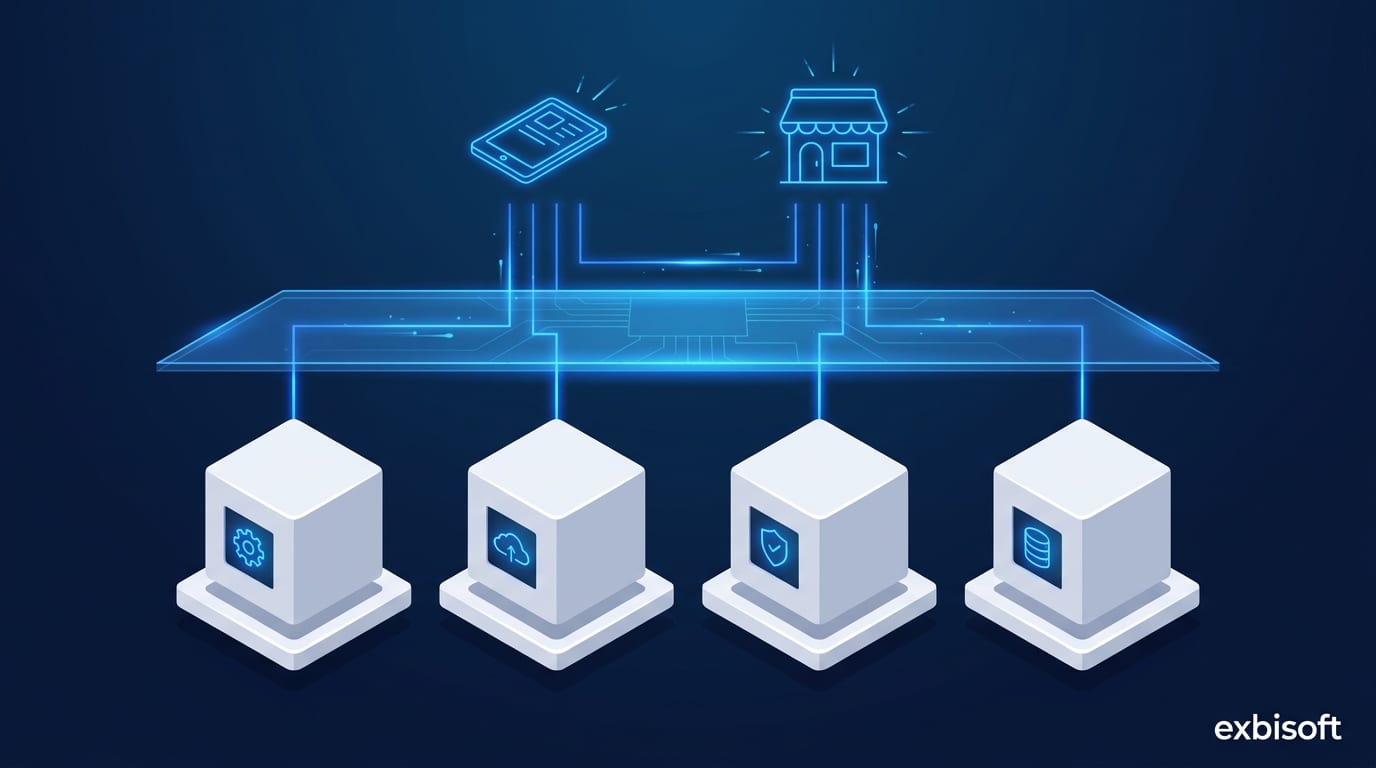
Replacing all of them to obtain that join means paying to rebuild capabilities you already have, plus a migration, plus retraining, plus the risk of running a critical business on something new. The alternative is to leave the systems where they are and build the connective layer above them.
A 500-device rollout that changed nothing behind it
The clearest example from our own work is a jewelry manufacturer in Hessen with more than 500 in-store kiosk touchpoints across Europe, running on ageing Windows tablets.
We rebuilt those touchpoints as a native iPad application. The important part is what we did not touch: the app connects to the client’s existing middleware layer, which handles synchronisation with SAP, without requiring any changes to the backend or the SAP environment. We worked directly with the middleware vendor so the integration was clean, documented, and reliable enough for a rollout at that scale.
So the customer-facing experience was modernised across an entire European store network, and the SAP environment — the part where change is slowest, riskiest and most expensive — was left alone. That is the shape of a good omnichannel project.
The connecting layer is real engineering, not a shortcut
It would be dishonest to present this as the easy option. A layer that joins systems has to be trustworthy, and that is where the work sits.
Our supply-chain intelligence platform sits between Zoho Inventory and Sellerboard for a garment manufacturer and shows what “trustworthy” requires in practice:
- Identity has to be resolved deliberately. Zoho item codes, Sellerboard SKUs, Amazon seller SKUs and ASINs all name the same thing differently. Every mapping is subject to manual approval.
- Ambiguity must be raised, not guessed. The system alerts on unmapped or ambiguous SKUs rather than silently dropping records — a connecting layer that quietly discards what it cannot match is worse than none.
- Disagreements become exceptions, not averages. Reconciliation surfaces differences in units, values, dates and refunds for review, instead of absorbing them into a spreadsheet nobody trusts.
That discipline is the difference between an integration that becomes the system of record for decisions and one that becomes another number people argue about.
When replacing really is the right call
Two situations genuinely justify it. First, when a core system cannot expose its data at all — no API, no supported export, no path in. You cannot connect to something that refuses to be connected to. Second, when the system is itself at end of life, so you would be building an integration onto a foundation that is scheduled to disappear.
Outside those two cases, the burden of proof should sit with replacement, not with connection.
Omnichannel is something customers experience, and no single product delivers it. The more useful question for a retailer is “what is the smallest change that makes our existing systems answer the questions customers are already asking?” For most retailers in fashion and apparel, that is integration and targeted modernisation — not a rebuild.
If you are being quoted for a replacement and suspect you need a connection, we are happy to give you a second opinion.
Go further
- Kiosk App case studyThe 500-device rollout that left SAP untouched.
- Supply Chain Intelligence Platform case studyThe connecting layer between Zoho Inventory and Sellerboard, with its rules for mapping and exceptions.
- Why Retail Software Breaks on ApparelOur earlier piece on why size and colour variants break standard retail systems, the problem underneath this one.