Photo: Google Gemini · AI-generated
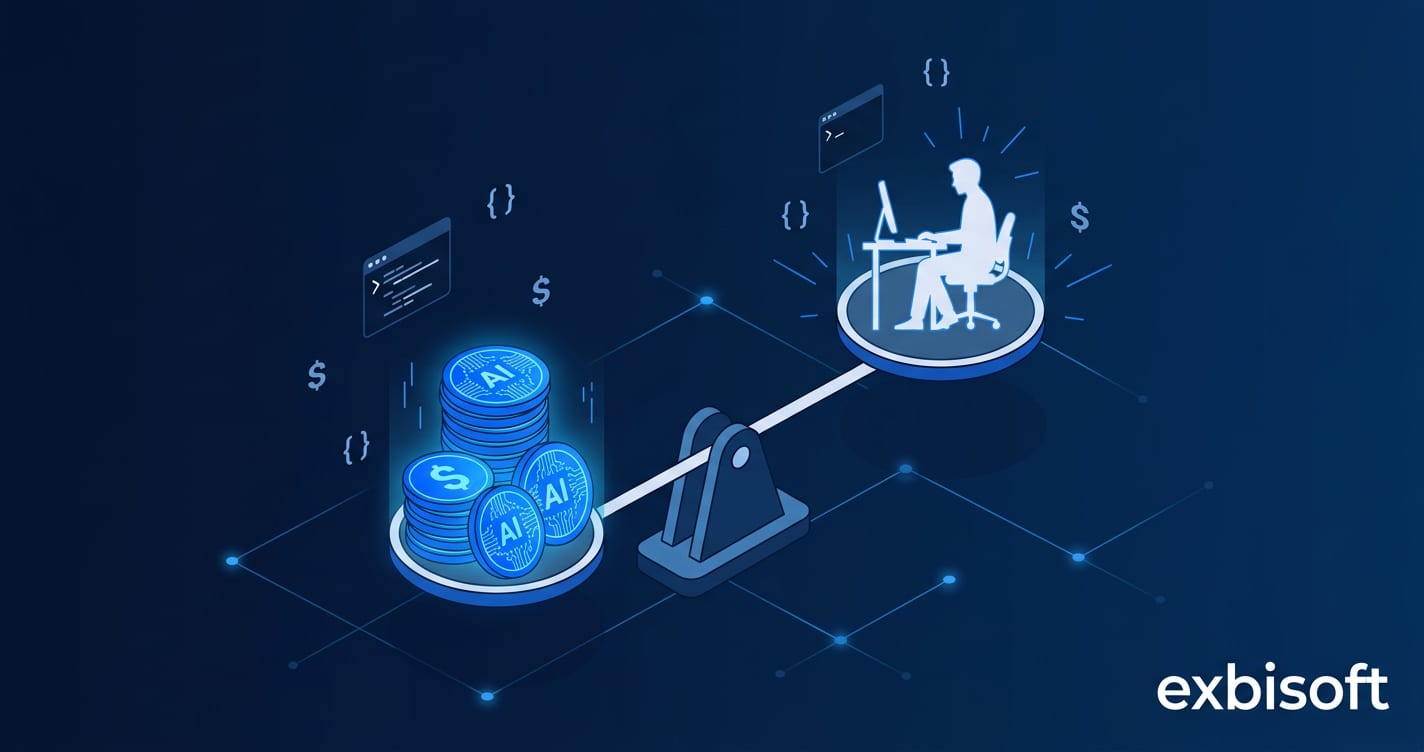
Gartner’s latest forecast landed this week with a headline that should make every CTO pause: by 2028, AI coding costs will exceed the global average developer salary — roughly US$2,000 per month. The driver is simple: token consumption is rising faster than anyone budgeted for, and providers are moving to consumption-based billing that makes costs hard to predict and harder to control.
The Heise article covering the forecast is worth reading in full. But the short version: companies that went all-in on AI coding agents without governing how tokens are consumed are now watching budgets evaporate.
The Uber warning sign
Uber’s CTO Praveen Neppalli Naga admitted in April that the company’s annual token budget had already been depleted. Uber’s President Andrew Macdonald followed up in May, saying the benefit of AI was “unclear” — no measurable increase in useful features for consumers had materialised.
This is not a small startup mismanaging a pilot. This is Uber — a company with world-class engineering — burning through its AI budget in months with nothing concrete to show for it.
A third of German companies are surprised by costs
According to a Bitkom survey, roughly a third of German companies have been surprised by the costs of their AI use. That tracks with what Gartner describes: providers lack transparency in token billing, offer no integrated cost optimisation, and companies have no internal controls over how agents consume tokens.
Gartner analyst Nitish Tyagi puts it plainly: developers “tend to favour convenience and speed over cost-efficiency.” Without governance, AI costs rise faster than the productivity gains they are supposed to deliver.
The model we chose instead
At exbisoft, we watched the vibe-coding wave with interest — and then deliberately chose a different path.
We retained our developers. Every one of them. We gave them AI tools — Claude Code, Cursor, GitHub Copilot — not as replacements, but as amplifiers. Our developers are experienced engineers who understand architecture, business logic, edge cases, and the difference between code that compiles and code that works in production for years.
The difference matters. An experienced developer using AI writes better code faster. An AI agent working without experienced oversight writes plausible code that may or may not survive contact with reality — and consumes tokens at a rate that makes it more expensive than the human it was supposed to replace.
Why the cost curve bends the wrong way
Gartner identifies the structural reasons costs will keep rising:
- Uncontrolled autonomy in agent-driven workflows — agents making recursive calls, expanding context windows, consuming tokens without human checkpoints
- Overloaded context windows — feeding entire codebases into prompts when targeted context would suffice
- Provider pricing pressure — infrastructure investment and profitability challenges will push model pricing higher, not lower
Their recommendations — token thresholds, automated monitoring, task segmentation to smaller models, prompt optimisation training — are all sensible. But they treat the symptom. The underlying problem is that companies tried to replace developer judgement with token throughput.
The real productivity equation
The question was never “can AI write code?” It can. The question is: at what cost, at what quality, and with what level of human oversight does the equation actually work?
Our answer: AI is a tool, not a replacement. A senior developer who knows the domain, understands the constraints, and uses AI to handle the mechanical parts — boilerplate, test generation, refactoring, documentation — gets genuine productivity gains without runaway token costs. They know when to use the tool and when to think for themselves.
That is not a philosophical position. It is a cost model that scales.
Companies replacing developers with AI agents will spend more for worse results. Companies investing in developers and giving them AI tools will spend less for better results. Gartner just put a timeline on when the first group discovers this the hard way.