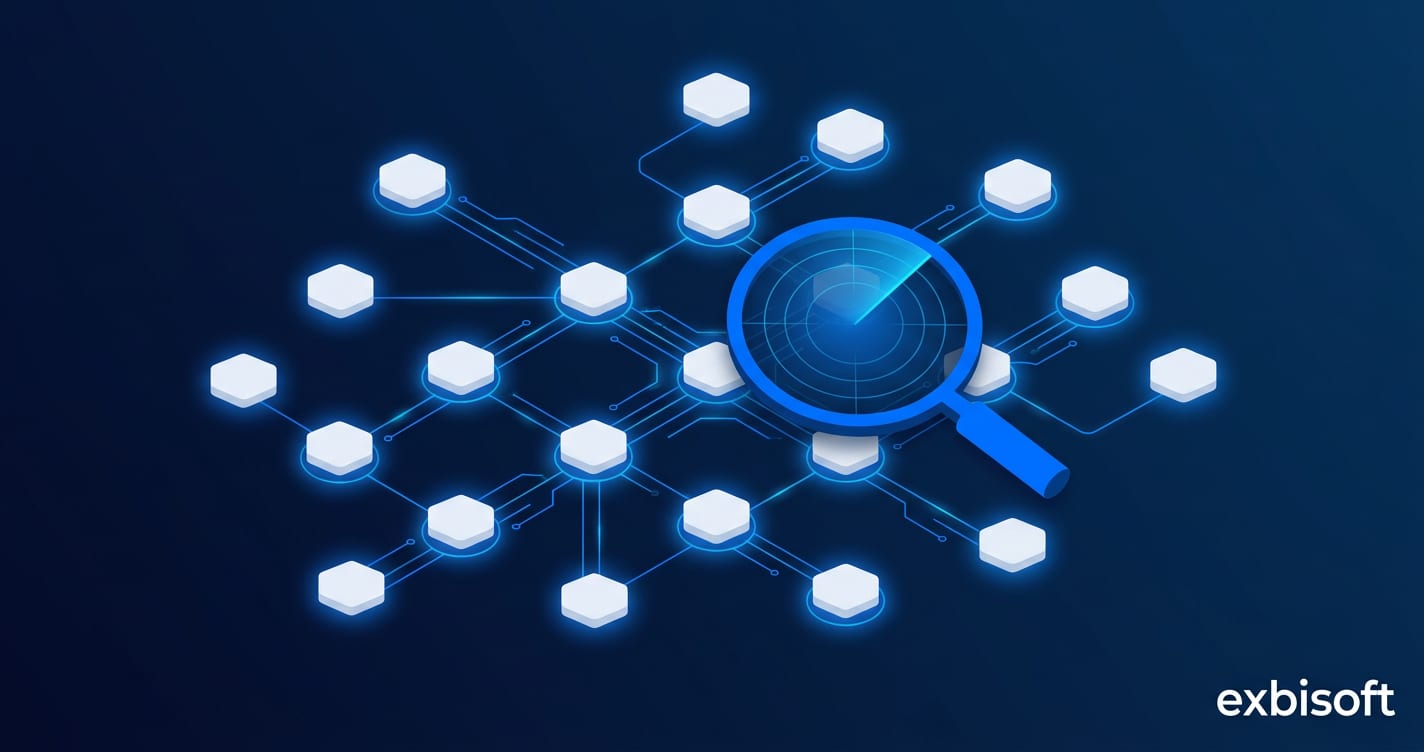
Photo: Google Gemini · AI-generated
Building AI agents is no longer the hard problem. The hard problem is finding the right agent for a given task — programmatically, at runtime, without a human browsing a marketplace.
On 17 June 2026, Microsoft, Google, and Hugging Face published the Agentic Resource Discovery (ARD) specification, an open standard that creates a common layer for publishing, indexing, and discovering AI capabilities across the web. The coalition behind it — Cisco, Databricks, GitHub, GoDaddy, NVIDIA, Salesforce, ServiceNow, and Snowflake — signals that this is not a side project. It is infrastructure.
What ARD actually does
ARD solves a specific problem: there is no standardised way for an AI agent to discover what other agents, tools, or APIs exist, what they can do, and how to connect to them. Today, that wiring is manual — hardcoded endpoints, curated lists, or platform-specific registries.
ARD introduces two primitives. First, a static manifest file (ai-catalog.json) hosted at /.well-known/ai-catalog.json on a publisher’s domain. This file describes agentic resources — MCP servers, A2A agents, skills, REST APIs — with structured metadata including capabilities, representative queries, compliance attestations, and invocation details. Second, a registry API that crawls published catalogues and responds to natural-language discovery queries with ranked results.
The discovery flow works like DNS for agents: you publish a catalogue on your domain, registries index it, an agent searches by intent, verifies the publisher, and connects over the resource’s native protocol — whether that is MCP, A2A, or a plain REST call.
What it is not
ARD sits entirely before invocation. It does not replace MCP (for tool integration) or A2A (for agent-to-agent communication). It answers the question that comes before both: which resource should I connect to? Think of it as the search layer that precedes the protocol layer.
The architecture is federated. There will be many registries — public, private, enterprise-internal — each indexing different resources, applying its own trust policies, and serving its own community. No single catalogue owns the ecosystem.
Why this matters for custom software
For companies building agent-powered systems — which is increasingly what our clients at exbisoft are doing — ARD addresses a real operational gap. Today, when you build an agent that needs to call another service, you wire that dependency by hand. When the landscape of available agents changes, nothing tells your system automatically.
With ARD, an enterprise could publish its internal MCP servers and A2A agents in a private registry, making them discoverable to other agents within the organisation. A logistics agent could find a compliance-checking agent at runtime. A customer support agent could discover a specialised knowledge-retrieval agent without a developer updating a configuration file.
The trust layer is particularly relevant for our clients in regulated industries. ARD embeds compliance attestations — SOC 2, HIPAA, GDPR — directly into catalogue entries, alongside cryptographic identity verification via SPIFFE or DID. That is not decoration. For a medical technology company or a financial services firm, knowing that a discovered agent meets specific compliance requirements before invoking it is a prerequisite, not a nice-to-have.
What we are watching
At exbisoft, we welcome ARD as a significant step toward composable agent architectures. We are particularly interested in how it can empower our AI customers to select appropriate agents fitting their specific needs — automatically, reliably, and with verifiable trust.
The specification is at v0.9 and will evolve. The critical question is adoption: how quickly publishers start hosting ai-catalog.json files, and whether the registry ecosystem develops enough diversity to be genuinely useful without becoming fragmented.
We will be evaluating ARD integration for client projects where agent discovery is currently a manual bottleneck. If your organisation is building with MCP servers or multi-agent systems, this specification deserves your attention.